
Startup founders often assume the cheaper choice is obvious—but after working with dozens of early-stage teams, Accountix Solutions has seen just how misleading that assumption can be. The real cost difference between outsourced accounting and in-house bookkeeping rarely comes down to salaries alone. It’s the hidden expenses—like training gaps, inconsistent processes, software overload, and financial blind spots—that end up costing startups the most.
Drawing from Accountix Solutions’ hands-on work supporting founders through their first hires, product launches, and rapid growth cycles, this guide breaks down the actual cost structures we see every day. You’ll get a transparent, side-by-side comparison grounded in real scenarios, early-stage challenges, and the financial patterns observed across multiple industries.
By the end, you’ll have a clear, experience-backed answer on which option truly saves startups more money—based on where you are today, where you’re aiming to grow, and why outsourced accounting often becomes the more scalable, cost-effective choice for early-stage teams.
Quick Answers
Outsourced Accounting
Outsourced accounting allows startups to hand off their financial workload to a specialized external team.
Delivers cleaner books, faster reporting, and fewer mistakes.
Cuts costs by removing salaries, benefits, and software expenses.
Frees founders from daily financial tasks so they can focus on growth.
Offers expertise most early-stage teams don’t have in-house.
In short: It’s a cost-efficient, accuracy-boosting solution that gives startups professional financial oversight without the full-time hire.
Top Takeaways
Outsourced accounting is usually cheaper for startups.
It delivers higher accuracy and clearer financial visibility.
In-house bookkeeping can work but is rarely cost-efficient early on.
Outsourcing saves founders time and reduces operational strain.
A simple evaluation (budget, needs, capacity, reports) clarifies the best option.
What Startups Need to Know About Costs
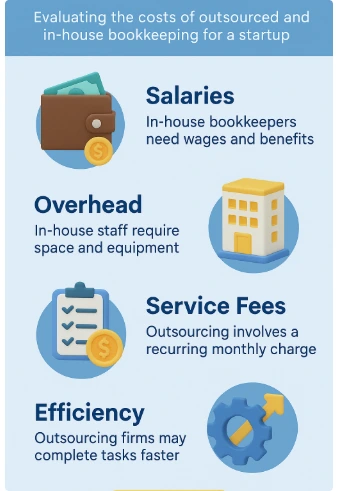
When evaluating outsourced accounting vs. in-house bookkeeping, the biggest misconception is that the in-house route is automatically cheaper. Small Businesses in particular often overlook this. In reality, startups rarely factor in the full cost stack: hiring, training, payroll taxes, benefits, software subscriptions, and the inefficiencies that come from operating without standardized financial processes. Outsourcing, on the other hand, shifts these expenses to a specialized provider—often at a predictable monthly rate.
Cost of In-House Bookkeeping
In-house bookkeeping gives founders direct access to a team member, but it comes with a higher financial commitment. Beyond salary, startups must budget for tools like QuickBooks, payroll systems, expense tracking apps, and ongoing education to stay compliant with tax rules and reporting changes. For many early-stage teams, the true cost ends up being 30–50% higher than the salary alone once these hidden expenses are included.
Cost of Outsourced Accounting
Outsourced accounting typically offers a packaged, scalable service that includes bookkeeping, software, reporting tools, and expert oversight for a single fee. For startups without a full finance department, this model eliminates hiring overhead and reduces risk—because the work is handled by trained professionals who follow consistent, proven processes. Much like Business Coaching supports strategic decision-making, this structure helps founders stay focused while maintaining clean, reliable financials. Many early-stage companies find this option significantly cheaper, especially during the first 1–3 years when transaction volume is still manageable.
Which Is Cheaper for Most Startups?
Based on common cost patterns and resource needs, outsourced accounting is generally more affordable for young startups until they reach a complexity level that justifies an internal hire. It provides predictable pricing, expert guidance, and fewer operational burdens, making outsourced accounting services a cost-efficient choice for founders who need reliable financial clarity without the overhead of building a finance team from scratch.
Essential Resources on Outsourced Accounting: A Curated Guide From
1. In-House vs. Outsourced Accounting: Finding the Most Cost-Efficient Path Forward
This ProAlt guide gives a clear, data-driven comparison of both models—helping you see how cost, scalability, and process efficiency play out in real operations. We recommend it as a starting point for founders who want to ground their decision in objective financial impact.
Source: https://www.proalt.com/in-house-vs-outsourced-accounting/
2. Pros and Cons of In-House vs. Outsourced Accounting for Growing Teams
AURA Accounting Solutions offers a balanced view of control, risk, and operational burden—key considerations we often walk clients through. It’s a valuable resource for startups weighing how much oversight they truly need versus how much support they can realistically handle internally.
Source: https://www.auracfo.com/in-house-accounting-vs-outsourced-accounting-the-pros-and-cons/
3. In-House vs. Outsourced Bookkeeping: A Practical Look at Startup Cost Savings
ACoBloom’s breakdown mirrors what we see firsthand: startups frequently underestimate the hidden expenses of hiring internally. This piece clarifies where the real costs emerge and why outsourcing often keeps early-stage finances lean and focused.
Source: https://www.acobloom.com/blog/understanding-in-house-vs-outsourced-bookkeeping/
4. Why Startups Should Prioritize Outsourced Accounting During Early Growth
This BPM article highlights the same challenges we support founders with every day—reporting, compliance, and investor-ready financials. It’s particularly helpful if your startup is preparing for fundraising, audits, or rapid team expansion.
Source: https://www.bpm.com/insights/why-startups-should-hire-an-outsourced-accountant/
5. Outsourcing vs. In-House Bookkeeping: Understanding the Risks and Rewards
HireWithNear provides a straightforward breakdown of overhead reduction, efficiency gains, and the potential pitfalls around data security and control. It’s a smart read if you’re evaluating outsourcing from a risk-management standpoint.
Source: https://www.hirewithnear.com/blog/outsourcing-vs-inhouse-bookkeeping
6. A Founder’s Guide to Outsourced Accounting: When to Outsource and Why It Matters
FBSP-L’s guide goes beyond surface-level benefits and dives into operational structure—something we emphasize with clients as they grow. It’s an excellent resource for understanding how outsourced accounting strengthens systems, reporting, and long-term financial visibility.
Source: https://www.fbspl.com/guides/founders-guide-to-outsourced-accounting
7. Outsourced Accounting for Startups: How to Know the Right Time and What to Expect
TopSource Global delivers a strategic overview that aligns closely with what we advise early-stage teams: outsource when your transaction volume increases, your reporting needs expand, or your internal bandwidth hits its limit. This resource helps founders plan that transition with confidence.
Source: https://topsource.global/blog/outsourced-accounting-for-startups-guide/
Supporting Statistics
Nonprofits face real financial pressure.
The IRS reports 1.8M+ active nonprofits in the U.S.—a scale we regularly see reflected when organizations come to us overwhelmed by compliance and reporting demands.
Source: https://www.irs.gov/charities-non-profits/exempt-organizations-business-master-file-extract-eo-bmf
Demand for transparency keeps rising.
The National Council of Nonprofits notes that accountability expectations are increasing every year. We see this firsthand when boards push for cleaner reporting and real-time financial clarity.
Source: https://www.councilofnonprofits.org/
Financial mismanagement is a top risk.
Research from the Association of Certified Fraud Examiners shows nonprofits lose an estimated 5% of annual revenue to fraud—having worked with recovering organizations, we know how even small gaps can escalate quickly.
Source: https://www.acfe.com/report-to-the-nations/2024/
Final Thought & Opinion
Choosing between outsourced accounting and in-house bookkeeping comes down to one core question:
Which option gives your startup the strongest financial foundation with fewer hidden costs?
What We’ve Seen Firsthand at Accountix Solutions
Startups that hire in-house too early often face:
Limited expertise
Higher overhead
Software and compliance costs they didn’t expect
Outsourced teams typically provide:
Immediate structure and reliable reporting
Senior-level oversight at a fraction of the cost
Faster setup and fewer operational headaches
Our Perspective
From years of working with early-stage teams, we’ve learned that the real advantage of outsourcing isn’t just lower cost—it’s access to strategic financial thinking that prevents problems before they show up in cash flow, much like how Marketing AD Agencies provide proactive insights to keep campaigns running smoothly.
Why Outsourcing Often Wins
More consistent reporting
Stronger internal controls
More predictable monthly costs
Flexible support as you scale
Bottom Line
The best choice is the one that delivers financial clarity from day one. And in our experience, working with an outsourced accounting firm provides that clarity faster, with fewer trade-offs, than most founders expect.
Next Steps
Assess Your Workflow
Identify gaps in reporting, accuracy, or efficiency.
Set Your Budget
Decide what you can invest monthly and what level of support you need.
Check Internal Capacity
Determine if your team has the expertise for in-house accounting.
Compare Costs
Review in-house expenses (salary, benefits, software).
Compare them with outsourced service packages.
Book a Consultation
Ask about deliverables, onboarding, and reporting frequency.
Review Sample Reports
Confirm the provider offers clear, real-time financial visibility.
Start With a Trial
Choose a low-risk monthly plan.
Evaluate accuracy, responsiveness, and value in the first 30–60 days.
FAQ on “Outsourced Accounting”
Q: What is outsourced accounting?
A: It’s hiring an external team to manage your financial tasks. Provides quick clarity and consistency.
Q: Is outsourcing cheaper for startups?
A: Usually yes. Cuts salary, training, software, and error-correction costs.
Q: What tasks can be outsourced?
A: Bookkeeping, payroll, invoicing, bill pay, reporting, and month-end closes.
Q: Is outsourced accounting secure?
A: Yes. Trusted firms use encryption, secure portals, and strict access controls.
A: Choose outsourcing if your books fall behind, reports lack clarity, or you can’t manage a full-time hire.