
Designers spend years on mechanics. The rulebook gets a weekend before the print deadline. That gap shows up the first time a stranger opens the box. Someone reads aloud. Someone else misreads a card. The host pulls up a YouTube playthrough on her phone. By the time the group agrees on what the rules actually say, the energy that took twenty minutes to build is gone.
That moment is where repeat plays die. A board game can have brilliant mechanics and still fail at the table because nobody can run turn one without help. The patterns below come from the rulebooks designers actually study — the ones that show up in BoardGameGeek discussions, in Stonemaier’s blog archives, and inside the games that earned a second printing.
TL;DR Quick Answers
Board Game Copywriting Services
Board game copywriting services are professional writing and editing services for tabletop game publishers, designers, and FLGS owners. The work typically includes:
Rulebook editing and rules reference creation
Kickstarter campaign page copy and pledge manager content
Product descriptions and packaging text
Web pages and SEO blogs aimed at the tabletop community
Email sequences for launch, fulfillment, and retention
Ad copy for Meta, Google, and YouTube campaigns
Most independent publishers bring in a specialist once a rulebook has been blind playtested twice and players still struggle to run a turn, or when a Kickstarter launch needs page copy, ads, and email working as one campaign instead of three disconnected pieces. A copywriter who edits rulebooks every week and understands brand development strategy writes in the language the tabletop community actually uses on BoardGameGeek and Reddit, which is where most tabletop buyers research what they play before they ever click "back this project."
Top Takeaways
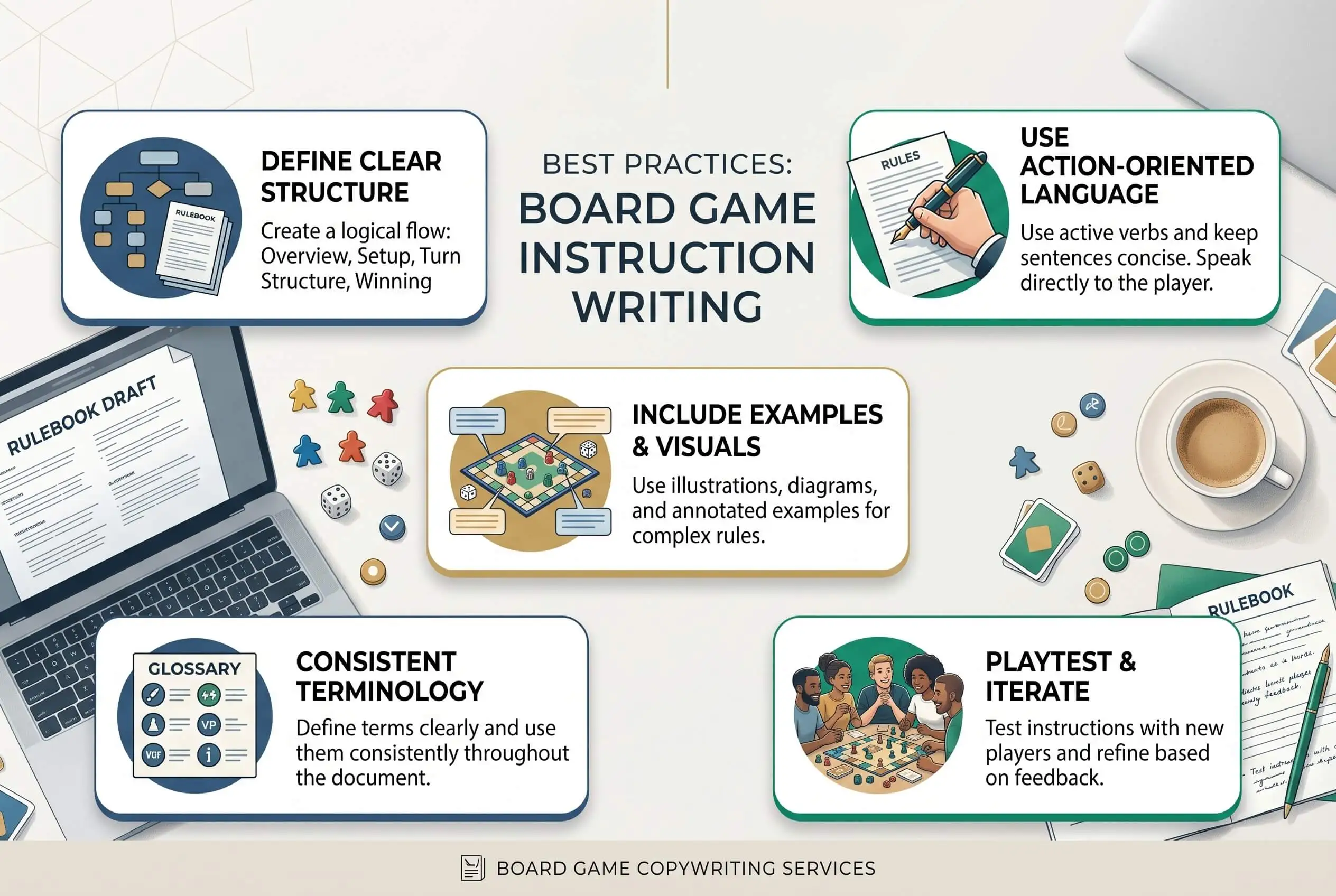
The clearest rulebooks share five habits:
Open with the goal. Players need to know the destination before the directions start mattering.
Choose one word per concept and keep it consistent on cards, reference sheets, and the box back.
Ship a learn-to-play for first-time players and a rules reference for in-game questions. Two documents beat one trying to do both jobs.
Add a quick-start summary so experienced gamers can skip the front matter and start playing.
Blind playtest the manual. Friendly playtests catch design issues, but the designer fills rulebook gaps verbally without realizing it.
Seven Best Practices That Make Board Game Rules Easier to Follow
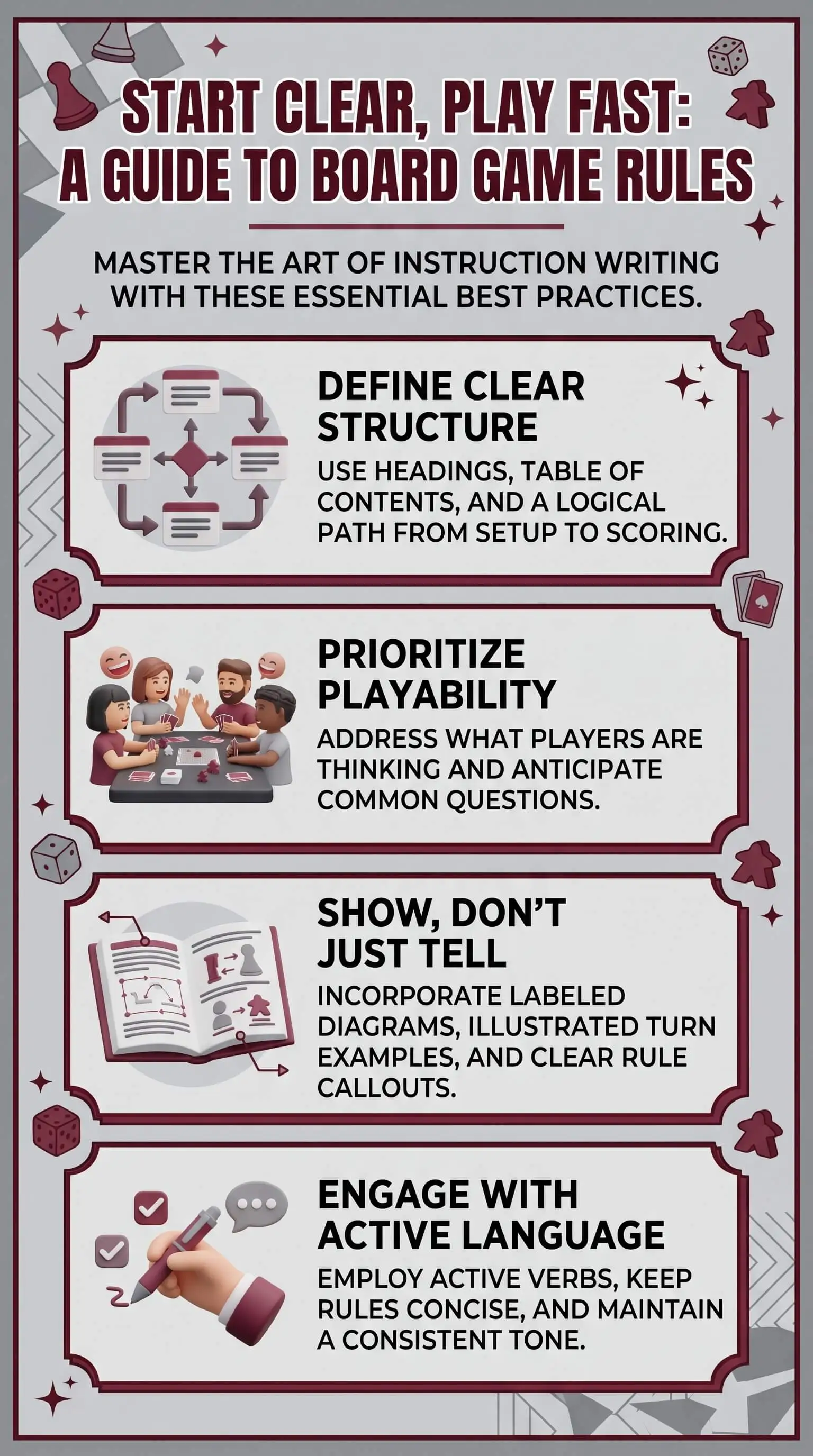
Editors who critique rulebooks for a living and understand how to brand yourself online tend to point at the same set of habits when they explain what “good” looks like. The seven below show up across BoardGameGeek’s highest-rated games and most of the rulebooks designers actually study.
Lead with the win condition, not the setup
Players want to know what they’re trying to do before they read how to do it. Open with the goal in one short paragraph, then describe setup. Twelve component descriptions on page one buries the only thing that motivates a new player to keep reading. With the destination already in mind, setup feels like preparation instead of an obstacle.
Define every term once, then never substitute
A token is a token. It isn’t a marker on page three, a chip on page seven, or a piece in the FAQ. Switching vocabulary forces players to re-read passages they thought they understood, and it makes the rules reference harder to search later. Pick the cleanest word for each concept and use it on every card, every reference sheet, and the box back.
Write phases in the order they happen
If a turn runs setup, action, then cleanup, describe it in that order. Don’t open with the action and flash back to setup conditions buried in a sub-clause. Players read rules in the order the rules describe them, so chronological writing matches how they think at the table. Conditional logic like “if you chose option A during setup” dropped inside an action description is one of the most common sources of confusion, and it’s almost always fixable by reordering the sentences.
Separate the rulebook from the rules reference
A rulebook teaches the game. A rules reference answers questions during play. Trying to do both in one document forces players to hunt through tutorial prose for a single edge case. Many newer publishers ship two documents: a learn-to-play that walks new players through their first session, and a rules reference organized alphabetically or by topic for in-game lookups. Smaller games can pull this off with one booklet plus a player aid card.
Build a quick-start path
A one-page summary, sometimes called a learn-to-play card or “first game” sidebar, lets experienced gamers skip the front matter and start playing. New players still get the full rulebook. Quick-start paths cut first-play friction, and they make a second play in the same evening more likely. That second play is where most word-of-mouth recommendations actually start.
Use diagrams for spatial rules
Adjacency, line of sight, range, stacking, and zone-of-control rules are nearly impossible to describe cleanly in prose. A small diagram with two or three labeled examples beats a paragraph of geometric description and pays off on every play. If a rule needs an example to make sense, it probably needs a diagram.
Test the rulebook without the designer in the room
A designer teaching a game in person fills every gap the rulebook leaves behind. To find those gaps, hand a sealed copy to people who’ve never seen the game and watch them try to start. Read their notes the next morning. If they couldn’t run a turn without help, the rulebook isn’t done. Most professional rulebooks go through six to ten revision passes once blind playtesting begins, and the version that ships rarely looks much like the first draft.
"After a few years editing rulebooks, the pattern I notice most is publishers calling about copywriting only once manufacturing is locked in. By then the rulebook is being asked to compensate for clarity issues that should have been caught during blind playtests. A copywriter can usually save the launch at that point. The projects that go best are the ones that bring editorial input in before the print files are due."
7 Essential Resources
Designers and editors who critique rulebooks for a living point to a small set of communities and references. These seven come up most often.
Stonemaier Games Style Guide: Jamey Stegmaier’s published style decisions for rulebooks, including capitalization conventions, second-person voice, and standard section order.
Meeple Mountain: Top Six Rules for Rulebook Writing: A practical breakdown of structure, with a recommended outline and notes on hiring a professional editor.
Cardboard Edison: A curated aggregator of board game design articles, podcast episodes, and reference materials, updated regularly by Chris and Suzanne Zinsli.
Board Game Designers Forum: Long-running designer community with active rulebook critique threads and a searchable archive of design discussions.
BoardGameGeek Game Design Forum: The largest active board game community, with thousands of archived rulebook discussions and direct feedback from working designers.
r/tabletopgamedesign: Active subreddit for design feedback, with weekly threads on rulebook critique and playtest reports.
Tabletop Game Designers Association: Industry organization with new-designer guides, a professional network, and resources that cover both rulebook writing and broader game design.
3 Statistics
Three numbers frame why rulebook editing is worth real investment.
Tabletop campaigns hit a record 80 percent success rate on Kickstarter in 2024, with 5,314 of 6,646 launched campaigns funded successfully. That’s the highest rate in the platform’s 15-year history. More new rulebooks are reaching more new players than at any prior point.
Bad writing costs U.S. businesses an estimated $400 billion in lost productivity each year, according to research cited by Inc. and Grammarly’s CEO. A confusing rulebook is the consumer version of the same problem. Time spent decoding instructions is time not spent playing.
American workers spend 22 percent of their work time reading, according to an analysis by Josh Bernoff. Players bring the same reading habits to the table. A rulebook that fights the reader loses, and most designers underestimate how fast that happens.
Final Thoughts and Opinion
Clarity belongs to the design work. A rulebook can be technically accurate and still impossible to read. Publishers whose games keep coming back to the table treat the manual as part of the product, edited and revised with as much attention as the box art.
That treatment costs time. Most rulebooks need six to ten revision passes after blind playtests, plus a separate rules reference for anything with real complexity. For a small team, that workload competes with graphic design, marketing copy, web pages, manufacturing coordination, fulfillment, and everything else a launch already demands.
When the workload outgrows the team, professional board game copywriting services and a specialized marketing agency can take rulebook revisions, web pages, and launch campaigns off the designer’s plate. The design work stays centered on the game, and the editorial work lands with someone who edits rulebooks every week. Most independent publishers see the result in their reviews and in how often the manual actually gets used after the first play.
Frequently Asked Questions
How long should a board game rulebook be?
Length depends on complexity. A light card game can ship a 1,000-word rulebook on a folded sheet. A heavy strategy game often runs 20 to 40 pages including diagrams, examples, and an index. The target is always the shortest version that lets a stranger run the game without outside help.
What’s the difference between a rulebook and a rules reference?
A rulebook teaches the game in chronological order: setup, gameplay, end conditions. A rules reference answers questions during play, usually organized alphabetically or by topic. New games ship both whenever the budget allows. One document trying to do both jobs almost always does both poorly.
How many playtests does a rulebook need?
Most professional rulebooks go through six to ten revision passes once blind playtesting begins. Blind playtests are where the real rulebook gaps surface. Friendly playtests catch design issues but rarely catch rulebook issues, because the designer is filling gaps verbally as the group plays.
Should every board game include a quick-start guide?
Almost always. A one-page summary, learn-to-play card, or “first game” sidebar improves first-play success and raises the chance of a second play in the same session. The exception is very light games whose entire rulebook is already shorter than a typical quick-start.
When should a designer hire a professional copywriter for rules?
Once the rulebook has been blind playtested twice and players still struggle to run a turn. At that point the editing problem is larger than the design team can fix in-house, and a specialist usually saves weeks of revision time. The case is strongest for games heading into Kickstarter or retail launch.
What software do designers use to write board game rules?
Early drafts usually live in Google Docs or Microsoft Word, where revisions and comments are easy to track. Final layout moves to Adobe InDesign or Affinity Publisher, because rulebooks need tight control over diagrams, sidebars, and image placement.
Keep Reading
Subscribe to the black-owned marketing agencies for more guides on niche content strategy, specialized copywriting, and editorial workflows for industries where clarity drives revenue. Working on a rulebook right now? Drop the link in the comments below. A second pair of eyes from another designer often catches what the designer in the room can’t.